
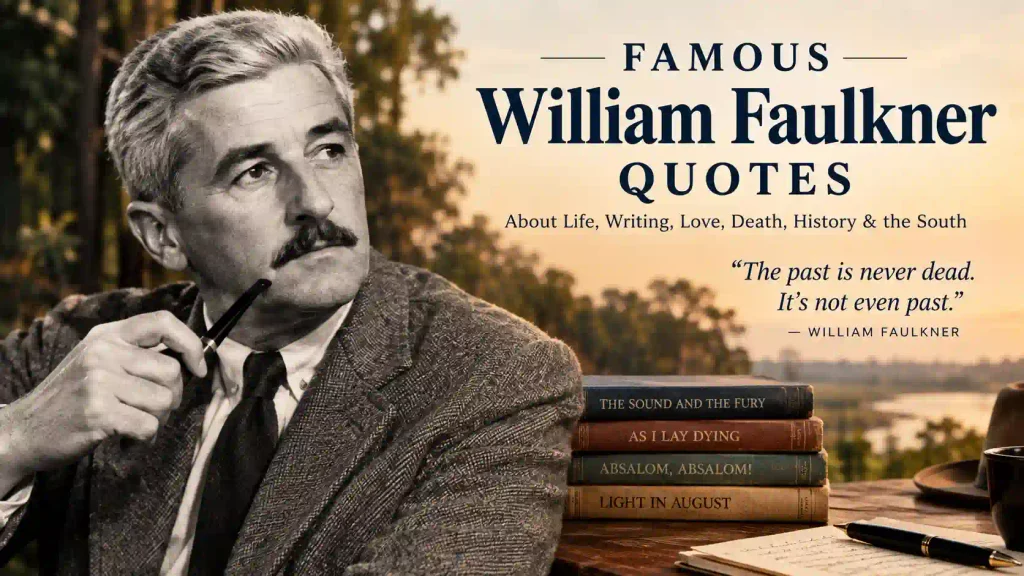
Looking for Faulkner Quotes? William Faulkner wrote about memory, love, death, family, history, the American South, and the struggle of the human heart. His fiction can be difficult, but his most famous lines often feel simple once you see the idea behind them.
If you are searching for Faulkner quotes, this collection brings together famous William Faulkner quotes from his novels, speeches, interviews, and public writing. It also covers Faulkner quotes on writing, life, love, death, history, reading, Mississippi, and the South.
One of his most famous lines comes from Requiem for a Nun:
“The past is never dead. It’s not even past.”
That sentence captures one of the ideas that runs through much of Faulkner’s work: the past does not simply disappear. It can continue to shape people, families, communities, and the present.
What Are Some Famous Faulkner Quotes?
Some of the best-known William Faulkner quotes include:
- “The past is never dead. It’s not even past.”
- “I believe that man will not merely endure: he will prevail.”
- “The writer’s duty is to write about these things.”
- “The human heart in conflict with itself.”
- “The only thing worth writing about is the human heart in conflict with itself.”
These lines come from different parts of Faulkner’s career, including Requiem for a Nun, his Nobel Prize speech, and his discussions about writing.
Famous William Faulkner Quotes
“The past is never dead. It’s not even past.”
This is one of the most famous William Faulkner quotes and comes from Requiem for a Nun.
The line is about more than remembering old events. Faulkner suggests that history can remain active in the present. Family history, personal choices, social conflicts, and old wounds can continue to influence people long after the original events have ended.
That idea helps explain why history matters so much in his fiction.
“I believe that man will not merely endure: he will prevail.”
Faulkner delivered this hopeful statement in his 1950 Nobel Prize acceptance speech.
The speech came during a period of fear about nuclear war. Instead of ending with despair, Faulkner argued for human endurance, compassion, courage, and the ability to survive hardship.
It remains one of his most inspirational lines.
“The human heart in conflict with itself.”
Faulkner used this phrase in his Nobel Prize speech when discussing what writers should write about.
For him, great stories came from human struggle. People want one thing and fear another. They love someone but hurt them. They remember the past while trying to build a future.
That tension sits at the center of much of his fiction.
“The writer’s duty is to write about these things.”
In the same Nobel speech, Faulkner spoke about love, honor, pity, pride, compassion, and sacrifice as enduring subjects for writers.
His point was not that every writer should tell the same story. It was that literature should remain connected to the deepest parts of human life.
William Faulkner Quotes on Writing
William Faulkner quotes on writing are useful because he often explained his craft in plain, direct language.
“I write by ear.”
Faulkner’s approach to language was strongly tied to sound, rhythm, voice, and character. His fiction often changes style depending on who is telling the story.
That approach can be seen clearly in The Sound and the Fury and As I Lay Dying, where different narrators create very different experiences.
“The novelist is a failed poet.”
Faulkner used this provocative idea when discussing literary forms. In a University of Virginia discussion, he compared poetry, short stories, and novels and explained why he saw the poet as able to express an idea with greater compression.
The line is useful because it shows how seriously Faulkner thought about economy, rhythm, and the pressure of language.
“The revision is … for the writer more than the editor’s revision, which is for the reader.”
Faulkner discussed revision in a 1957 University of Virginia writing class.
He described writing as a process of changing and refining the work until it comes closer to the writer’s ideal. That makes his advice useful not only for novelists but also for anyone who writes.
Inspirational William Faulkner Quotes
Faulkner was often associated with difficult subjects, but his work also contains strong ideas about endurance and hope.
“I believe that man will not merely endure: he will prevail.”
This remains his clearest inspirational statement.
It does not promise an easy life. Instead, it argues that people possess qualities that can help them survive hardship: courage, compassion, sacrifice, endurance, and the ability to keep going.
“He has a soul, a spirit capable of compassion and sacrifice and endurance.”
This comes from the same Nobel speech.
Faulkner’s message was that human strength is not measured only by physical power. Compassion and sacrifice also matter.
William Faulkner Quotes About Life
William Faulkner quotes about life often return to struggle, memory, change, and the human need to keep moving.
His work rarely presents life as simple. Characters make mistakes. Families carry old wounds. People want things they cannot have.
Yet Faulkner repeatedly returned to the idea that people continue.
His Nobel speech gives that idea its clearest form: humanity may suffer, but it can endure and prevail.
William Faulkner Quotes on Death
Death appears throughout Faulkner’s fiction, but he rarely treats it as an isolated event.
In novels such as As I Lay Dying and The Sound and the Fury, death changes the people left behind. It affects memory, family relationships, guilt, love, and identity.
This is one reason Faulkner quotes on death can feel less like simple statements about dying and more like observations about what remains after someone is gone.
A particularly useful line for understanding this theme is:
“The past is never dead. It’s not even past.”
In Faulkner’s work, death does not always end a person’s influence. Memory can keep the dead present in the lives of those who remain.
Faulkner Quotes About Love
William Faulkner quotes about love often show love as complicated rather than sentimental.
In a University of Virginia discussion, Faulkner talked about people seeking love and explained that this search does not have to mean romantic love. He connected it with a broader human desire to belong to something larger than oneself.
That idea appears across his fiction.
Love in Faulkner can bring comfort, but it can also create jealousy, obsession, grief, sacrifice, and conflict.
Faulkner Quotes on History
Faulkner’s famous line about the past is also one of his most important statements about history:
“The past is never dead. It’s not even past.”
The line comes from Requiem for a Nun and has become closely associated with Faulkner’s treatment of Southern history.
His fictional world repeatedly shows characters living with the consequences of earlier generations. The past becomes part of family identity, social structures, personal memory, and community conflict.
This is why Faulkner quotes about history remain relevant far beyond literary study.
William Faulkner Quotes About Mississippi
Mississippi was central to Faulkner’s imagination.
He was born in New Albany, Mississippi, and grew up in Oxford. He later transformed the landscape and culture he knew into the fictional Yoknapatawpha County.
One of his most useful comments about place was his description of his “little postage stamp of native soil.”
The idea was simple: a writer does not need the whole world as a subject. A small, familiar place can contain enough human experience for a lifetime of stories.
Faulkner turned Mississippi into that kind of literary world.
Faulkner Quotes About the South
Faulkner’s fiction is deeply tied to the American South, particularly its history, family structures, social changes, racial conflicts, and relationship with the past.
But his South is not simply a setting.
It becomes a way to examine universal questions about memory, guilt, power, identity, love, and change.
That is why Faulkner quotes about the South often work on two levels. They describe a particular region while also asking broader questions about how people live with history.
Faulkner Quotes: As I Lay Dying
As I Lay Dying is one of Faulkner’s most distinctive novels.
Published in 1930, it follows the Bundren family as they travel across Mississippi to fulfill Addie Bundren’s final wish. The story uses multiple narrators, giving readers different versions of the same family and the same journey.
For readers searching for Faulkner quotes As I Lay Dying or William Faulkner quotes As I Lay Dying, the novel is especially rich in short, memorable passages.
One of its most famous brief lines is:
“My mother is a fish.”
The sentence comes from Vardaman, a young character struggling to understand his mother’s death.
The power of the line comes from its simplicity. Vardaman cannot process death in an adult way, so he connects his mother’s body with the fish he has caught.
Faulkner’s technique makes the reader experience grief through a child’s mind rather than through a traditional explanation.
William Faulkner on Writing As I Lay Dying
Faulkner later explained that he deliberately set out to write the novel as a technical challenge.
He said he knew the last word and almost where the last period would fall before he began writing.
That detail is useful for readers studying the novel because its unusual structure was not accidental. Faulkner designed the book around its many voices and shifting points of view.
Faulkner Quotes: The Sound and the Fury
The Sound and the Fury is one of William Faulkner’s most famous novels.
It follows the decline of the Compson family and uses several perspectives to tell the story.
Faulkner later described the novel as the work he loved most because it caused him the most difficulty and demanded the most effort.
That makes it especially relevant to readers searching for Faulkner quotes Sound and Fury.
One memorable passage begins with:
“I give you the mausoleum of all hope and desire.”
The image connects hope, desire, memory, and time. It is spoken in Quentin Compson’s section of the novel, where time becomes one of the central forces in his thinking.
A Rose for Emily William Faulkner Quotes
“A Rose for Emily” is one of Faulkner’s most widely taught short stories.
It follows Emily Grierson, a woman whose life becomes trapped between the old Southern social order and a changing world.
For readers searching for A Rose for Emily William Faulkner quotes, one of the story’s key ideas is the relationship between the past and the present.
Faulkner himself explained in a recorded discussion that the story began as a picture of a strand of hair on a pillow in an abandoned house.
That small image became a story about isolation, death, memory, social change, and the refusal to let go.
Absalom, Absalom! Quotes
Absalom, Absalom! is another major Faulkner novel built around memory and history.
The story examines Thomas Sutpen and the consequences of his ambitions, choices, and relationships.
Readers searching for Absalom, Absalom quotes will find many passages concerned with the way people reconstruct the past.
The novel is especially useful for understanding Faulkner’s interest in how history is remembered. The past does not arrive as one clean account. Different people interpret it, reshape it, and try to understand it.
That idea connects directly with the famous Faulkner line about the past never being truly past.
Faulkner Quotes on Reading
Faulkner had a practical view of reading.
In a University of Virginia discussion, he explained that he did not think readers needed someone to create a fixed reading schedule for his books. Instead, he suggested opening a book and reading a few pages to see if it held your interest.
His advice was personal rather than prescriptive.
That is a useful lesson for readers approaching Faulkner today. You do not have to understand every sentence on the first page. Start with the book that interests you most, then give yourself time to adjust to his style.
Faulkner Passages Worth Reading Closely
Some Faulkner passages are best understood in context rather than as isolated quotes.
Pay particular attention to:
- The opening of The Sound and the Fury
- The changing narrators in As I Lay Dying
- The discussion of history in Requiem for a Nun
- The ending of A Rose for Emily
- The shifting accounts of the past in Absalom, Absalom!
- The Nobel Prize acceptance speech
These passages show how Faulkner’s ideas work inside stories rather than simply appearing as standalone sayings.
William Faulkner Famous Works
William Faulkner wrote novels, short stories, essays, poems, screenplays, and other works.
Some of his best-known works include:
- The Sound and the Fury
- As I Lay Dying
- Absalom, Absalom!
- Light in August
- A Rose for Emily
- Requiem for a Nun
- The Unvanquished
- Go Down, Moses
- Sanctuary
- The Reivers
The Nobel Prize describes Faulkner as an important modern American novelist and notes his use of multiple viewpoints, stream of consciousness, and the fictional Yoknapatawpha County setting.
What Is Faulkner Most Famous For?
William Faulkner is most famous for his novels and stories about the American South, especially his fictional Yoknapatawpha County.
He is also known for his experimental narrative techniques, complex characters, stream-of-consciousness writing, and recurring focus on memory, history, race, family, and human conflict.
He received the Nobel Prize in Literature for 1949, with the Nobel Foundation citing his “powerful and artistically unique contribution to the modern American novel.”
His best-known works include The Sound and the Fury, As I Lay Dying, Absalom, Absalom!, and Light in August.
What Is Faulkner’s Masterpiece?
There is no single objective answer to this question.
The Sound and the Fury is often described by publishers and literary critics as Faulkner’s masterpiece. More importantly, Faulkner himself repeatedly singled it out as the work he loved most.
In a University of Virginia recording, he explained that it was the novel he had worked on the longest and hardest.
That makes The Sound and the Fury a particularly strong answer to the question, “What is Faulkner’s masterpiece?” while recognizing that readers and scholars may favor different works.
Is “Faulkner” on Wikiquote Reliable?
Faulkner – Wikiquote can be useful for discovering quotations and locating possible sources, but it should not be treated as the final authority for attribution.
Quote databases can contain errors, shortened versions, paraphrases, or quotations without enough context.
For important William Faulkner quotes, verify the wording against the original novel, speech, interview, or an authoritative archive such as the University of Virginia’s Faulkner at Virginia collection.
Harris Faulkner Quotes: Are They by William Faulkner?
No.
Harris Faulkner is a journalist and television news personality. William Faulkner was the Nobel Prize-winning American novelist who lived from 1897 to 1962.
The search phrase “Harris Faulkner quotes” can therefore lead to a completely different person.
If you are looking for literary quotations about writing, life, history, or the South, you want William Faulkner, not Harris Faulkner.
Wiliam Faulkner Quotes: A Common Spelling
“Wiliam Faulkner quotes” is a common misspelling of “William Faulkner quotes.”
The correct spelling is William Faulkner.
His full name was William Cuthbert Faulkner, and he was born in New Albany, Mississippi, in 1897.
What Is the Most Famous Quote Ever Said?
There is no universally accepted single “most famous quote ever said.”
Popularity changes by country, generation, language, subject, and source.
For William Faulkner, however, “The past is never dead. It’s not even past” is consistently identified as one of his best-known lines.
It has become so closely associated with his work because it captures one of his central literary concerns: the continuing influence of history.
Frequently Asked Questions About Faulkner Quotes
What are some famous Faulkner quotes?
Some of the best-known William Faulkner quotes include “The past is never dead. It’s not even past” and “I believe that man will not merely endure: he will prevail.” His Nobel Prize speech also contains several famous observations about writing and the human heart.
What is a famous quote by William Faulkner about writing?
One famous William Faulkner quote about writing concerns “the human heart in conflict with itself.” In his Nobel speech, Faulkner argued that writers should return to the enduring human subjects of love, honor, pity, compassion, and sacrifice.
What is a famous quote by William Faulkner about history?
The best-known William Faulkner quote about history is, “The past is never dead. It’s not even past.” It appears in Requiem for a Nun and expresses the idea that history continues to shape the present.
What are the best William Faulkner quotes on writing?
Among the most useful William Faulkner quotes on writing are his comments about the human heart in conflict, revision, the writer’s responsibility, and the relationship between poetry, short stories, and novels.
What are some William Faulkner quotes about life?
William Faulkner quotes about life often focus on endurance, struggle, memory, love, and the need to continue despite hardship. His Nobel statement about humanity enduring and prevailing is one of his clearest examples.
What are some William Faulkner quotes on death?
Faulkner’s writing contains many reflections on death, particularly in As I Lay Dying and The Sound and the Fury. His treatment of death often focuses on the effect it has on the living and the way memory keeps the past present.
What are some Faulkner quotes about love?
Faulkner discussed love as a broad human need, not only romantic love. His fiction also explores love through family, loyalty, obsession, sacrifice, grief, and the desire to belong.
What is the most famous Faulkner quote about the past?
“The past is never dead. It’s not even past” is the most famous Faulkner quote about the past. It comes from Requiem for a Nun.
What is Faulkner famous for?
William Faulkner is famous for his novels and short stories about the American South, his experimental narrative style, his fictional Yoknapatawpha County, and works such as The Sound and the Fury, As I Lay Dying, and Absalom, Absalom! He won the Nobel Prize in Literature for 1949.
What is Faulkner’s masterpiece?
The Sound and the Fury is often called Faulkner’s masterpiece. Faulkner himself regarded it as the work he loved most, largely because of the difficulty and effort involved in writing it.
What are some Faulkner quotes from As I Lay Dying?
As I Lay Dying contains many memorable passages, including the brief statement “My mother is a fish.” The novel uses fifteen narrators and explores death, family, grief, identity, and the different ways people understand the same event.
What are some Faulkner quotes from The Sound and the Fury?
The Sound and the Fury contains many memorable passages about time, memory, family, and loss. One well-known passage begins, “I give you the mausoleum of all hope and desire.”
What are some A Rose for Emily William Faulkner quotes?
“A Rose for Emily” contains memorable passages about isolation, death, tradition, memory, and the changing South. The story’s final revelation gives earlier descriptions of Emily’s life a darker meaning.
What are some William Faulkner quotes about Mississippi?
Faulkner often wrote about Mississippi through his fictional Yoknapatawpha County. He also described his own region as his “little postage stamp of native soil,” reflecting his belief that a small familiar place could provide material for a lifetime of writing.
What are some Faulkner quotes about the South?
Faulkner’s writing about the South often focuses on history, family, race, memory, social change, and the tension between old traditions and new realities. “The past is never dead. It’s not even past” is especially closely tied to these themes.
Are Harris Faulkner quotes the same as William Faulkner quotes?
No. Harris Faulkner and William Faulkner are different people. Harris Faulkner is a journalist and television personality, while William Faulkner was the Nobel Prize-winning novelist.
Final Thoughts on Faulkner Quotes
The best Faulkner quotes last because they do more than sound clever.
They ask hard questions about memory, love, death, writing, history, family, and the human need to keep going.
“The past is never dead. It’s not even past” remains his most recognizable statement about history.
“I believe that man will not merely endure: he will prevail” gives his work a note of hope.
And his repeated focus on the human heart explains why his fiction still matters.
William Faulkner wrote deeply about Mississippi and the American South, but his subjects were never limited to one place. His characters struggle with the same things people still face: love, loss, memory, ambition, guilt, fear, and the need to make sense of the past.
That is why famous William Faulkner quotes continue to be read long after the books were first published.

Qaiser Abbas is a content strategist and SEO writer at PressoraNetwork creating research-driven content, language guides, and practical resources that help readers. Words That Matter, Content That Connects. My goal is to help people express their emotions with meaningful words and make every celebration more memorable.