
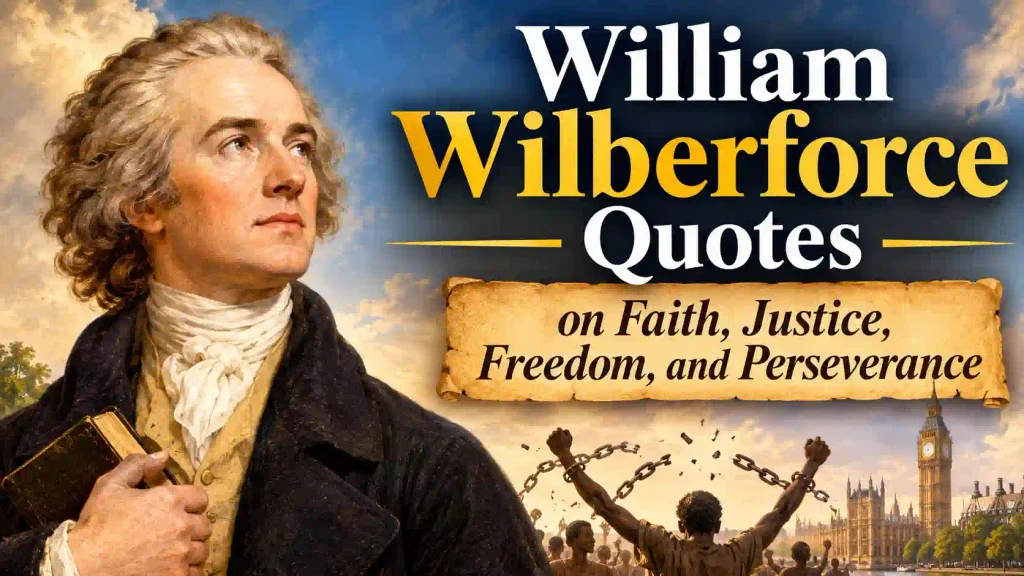
William Wilberforce Quotes believed that faith should inspire action and that justice should never be sacrificed for political convenience. As a British politician and leading campaigner against the transatlantic slave trade, he spent much of his public life fighting an institution that caused immense human suffering.
His speeches and personal writings reveal a man deeply concerned with conscience, Christian faith, moral responsibility, and perseverance. These William Wilberforce quotes offer insight into his beliefs and the principles that shaped his work.
Whether you’re looking for inspiration about standing up for what is right, strengthening your faith, or understanding the history of abolition, these carefully selected words provide a meaningful place to begin.
William Wilberforce Quotes on Justice and Equality
Justice was central to Wilberforce’s campaign against the slave trade. In his parliamentary speeches, he argued that economic interests could never justify treating human beings as property.
– “The principle, however, upon which I found the necessity of abolition is not Policy but Justice.” — William Wilberforce, 1789 speech.
– “We are all guilty—we ought all to plead guilty.” — William Wilberforce, 1789 speech.
– “There is a principle above every thing that is political.” — William Wilberforce, 1789 speech.
– “The dictates of conscience, the principles of justice, the laws of religion, and of God.” — William Wilberforce, 1789 speech.
– “Total abolition is the only possible cure for it.” — William Wilberforce, 1789 speech.
These words reflect his argument that justice must come before convenience, profit, or political advantage. His campaign challenged Parliament to confront the consequences of a system that denied people their freedom and dignity.
The quotations come from his speech on the abolition of the slave trade, delivered in the House of Commons in May 1789.
William Wilberforce Quotes About Faith and God
Wilberforce’s Christian faith influenced his personal life and public convictions. His private reflections reveal a continuing desire to grow spiritually, depend on God, and live according to his religious beliefs.
– “Though I am weak He is strong.” — William Wilberforce, personal reflection, November 22, 1792.
– “By His grace I will persevere with more earnestness than ever.” — William Wilberforce, personal reflection.
– “Let me take courage, relying on the sure promises of God in Christ.” — William Wilberforce, personal reflection.
– “Oh how unavailing is all but the grace of God to change the heart!” — William Wilberforce, personal reflection, October 13, 1792.
– “What folly is all else!” — William Wilberforce, personal reflection, November 22, 1792.
His writings show that faith was not simply a public identity for Wilberforce. It was also a personal discipline involving prayer, self-examination, humility, and a continual effort to improve his character.
These excerpts are drawn from published collections of his spiritual reflections.
William Wilberforce Quotes on Courage and Standing Up for What Is Right
Wilberforce’s campaign faced years of opposition. His 1789 speech reveals that he understood the difficulty of challenging an established institution, yet he believed the evidence and principles behind his cause justified continuing.
– “I take courage—I determine to forget all my other fears.” — William Wilberforce, 1789 speech.
– “I march forward with a firmer step.” — William Wilberforce, 1789 speech.
– “I should not have been faithful to the sight of my eyes, to the use of my senses and my reason, if I had shrunk from attempting the abolition.” — William Wilberforce, 1789 speech.
– “I am not ashamed to say it.” — William Wilberforce, 1789 speech.
– “Let not Parliament be the only body that is insensible to the principles of national justice.” — William Wilberforce, 1789 speech.
These quotations are particularly meaningful for people facing pressure to remain silent when something is wrong.
Wilberforce’s example demonstrates the importance of examining difficult issues, trusting sound principles, and having the courage to act on one’s convictions.
William Wilberforce Quotes About Perseverance and Never Giving Up
Wilberforce’s abolition campaign was not an overnight success. His efforts continued through years of parliamentary debate, political resistance, and repeated setbacks.
His words reveal his determination to continue working toward a cause he considered morally necessary.
– “I from this time determined that I would never rest till I had effected its abolition.” — William Wilberforce, 1789 speech.
– “By His grace I will persevere with more earnestness than ever.” — William Wilberforce, personal reflection.
– “Let me take courage.” — William Wilberforce, personal reflection.
– “With God, nothing is impossible.” — William Wilberforce, personal reflection as recorded in his spiritual reflections.
– “The struggle how short, compared with the eternity which follows it!” — William Wilberforce, personal reflection.
His perseverance was rooted in both religious conviction and his belief that meaningful change required sustained effort.
The slave trade was abolished throughout the British Empire in 1807, but the broader struggle against slavery continued. Wilberforce remained involved in the abolition movement until his retirement from Parliament.
William Wilberforce Quotes on Freedom and Human Dignity
Freedom and human dignity were at the heart of Wilberforce’s opposition to the slave trade. He challenged the idea that commercial success could justify the suffering and exploitation of other people.
– “The total Abolition of the Slave Trade.” — William Wilberforce, 1789 speech.
– “We can no longer plead ignorance.” — William Wilberforce, 1789 speech.
– “We cannot turn aside so as to avoid seeing it.” — William Wilberforce, 1789 speech.
– “Let us make reparation to Africa, so far as we can.” — William Wilberforce, 1789 speech.
– “The interests, not of this country, nor of Europe alone, but of the whole world, and of posterity, are involved.” — William Wilberforce, 1789 speech.
These statements reflect his argument that the consequences of injustice extended far beyond individual political decisions.
His campaign helped bring the suffering caused by the British slave trade into public and parliamentary debate. His historical legacy is closely connected to the movement that secured the British slave trade’s abolition in 1807.
Wikisource, the free online library+1
William Wilberforce Quotes About Conscience and Moral Responsibility
Wilberforce repeatedly argued that people should not ignore wrongdoing simply because it is accepted by society or supported by powerful institutions.
His speeches challenged Parliament to take responsibility for its decisions rather than shifting blame elsewhere.
– “We are all guilty—we ought all to plead guilty.” — William Wilberforce, 1789 speech.
– “We can no longer plead ignorance.” — William Wilberforce, 1789 speech.
– “Policy, however, Sir, is not my principle.” — William Wilberforce, 1789 speech.
– “How can I dare to set up any reasonings of my own against it?” — William Wilberforce, 1789 speech.
– “The rectitude of the grounds and principles of their decision.” — William Wilberforce, 1789 speech.
These words offer a reminder that moral responsibility requires more than recognizing a problem. It requires an honest response.
For readers interested in leadership, integrity, and ethical decision-making, this part of Wilberforce’s work remains especially relevant.
Wikisource, the free online library+1
Short William Wilberforce Quotes to Remember
Sometimes a few words can capture a powerful idea. These shorter excerpts from Wilberforce’s speeches and personal reflections are easy to remember and share.
- “I take courage.” — William Wilberforce.
- “Though I am weak He is strong.” — William Wilberforce.
- “Let me take courage.” — William Wilberforce.
- “Policy, however, Sir, is not my principle.” — William Wilberforce.
- “We can no longer plead ignorance.” — William Wilberforce.
- “Total abolition is the only possible cure for it.” — William Wilberforce.
- “With God, nothing is impossible.” — William Wilberforce.
- “I shall never rest till I had effected its abolition.” — William Wilberforce, excerpt adapted grammatically from his 1789 speech.
These selections work well for history projects, educational presentations, inspirational posts, and reflections about faith and personal responsibility.
What Did William Wilberforce Believe In?
William Wilberforce was a committed Christian, British parliamentarian, and prominent campaigner against the transatlantic slave trade.
His beliefs centered on several important principles:
- Christian faith: He believed that faith should influence everyday conduct and moral choices.
- Justice: He argued that political and economic interests should not outweigh basic principles of right and wrong.
- Human dignity: He opposed the slave trade because it involved violence, exploitation, and the denial of human freedom.
- Moral responsibility: He believed people should acknowledge injustice rather than excuse or ignore it.
- Perseverance: He continued his campaign despite political resistance and repeated setbacks.
His political and religious views also reflected the social and historical context of eighteenth- and nineteenth-century Britain. Understanding that context helps readers appreciate his contribution without treating any historical figure as beyond criticism.
Why Are William Wilberforce’s Words Still Relevant Today?
William Wilberforce’s words remain relevant because they address questions that extend beyond his own lifetime.
His speeches encourage readers to consider what happens when profit takes priority over people, when political convenience overrides justice, or when individuals choose silence over responsibility.
His life also illustrates that lasting social change can require years of consistent work.
For students, his writings offer historical insight into abolitionism and British parliamentary history. For readers interested in Christian inspiration, his private reflections provide a glimpse into his personal faith. For anyone thinking about courage and perseverance, his campaign demonstrates the importance of remaining committed to a meaningful cause.
His legacy should also be understood accurately: the 1807 Act abolished the British slave trade, not slavery itself. Slavery in most of the British Empire was addressed by the Slavery Abolition Act of 1833, passed shortly before Wilberforce’s death.
OUP Academic+1
William Wilberforce Quotes on Slavery and Against the Slave Trade
William Wilberforce is best remembered for his determined campaign against the British slave trade. His speeches in Parliament challenged the economic arguments used to defend slavery and called attention to the suffering of enslaved Africans.
The following William Wilberforce quotes on slavery come from his historical speeches and writings.
– “The principle, however, upon which I found the necessity of abolition is not Policy but Justice.” — William Wilberforce, 1789 speech.
– “We are all guilty—we ought all to plead guilty.” — William Wilberforce, 1789 speech.
– “Total abolition is the only possible cure for it.” — William Wilberforce, 1789 speech.
– “I determine to forget all my other fears, and I march forward with a firmer step.” — William Wilberforce, 1789 speech.
– “I from this time determined that I would never rest till I had effected its abolition.” — William Wilberforce, 1789 speech.
– “The interests, not of this country, nor of Europe alone, but of the whole world, and of posterity, are involved.” — William Wilberforce, 1789 speech.
– “Let us then withdraw from these wretched Africans, those temptations to fraud, violence, cruelty, and injustice, which the Slave Trade furnishes.” — William Wilberforce, 1789 speech.
– “Total abolition is the only possible cure for it.” — William Wilberforce, 1789 speech.
These statements show why Wilberforce believed that ending the slave trade required more than minor reforms. He argued that the trade itself was unjust and that Parliament had a moral responsibility to end it.
His 1789 speech became an important moment in the parliamentary abolition campaign, although the final abolition legislation did not pass until 1807.
Wikisource, the free online library+2
William Wilberforce’s Famous “Look the Other Way” Quote
One quotation frequently associated with William Wilberforce reads:
“You may choose to look the other way but you can never again say you did not know.”
It is commonly presented as a statement from one of his speeches against the slave trade, sometimes dated to 1791.
However, there is an important attribution issue. The wording is repeated in modern quotation collections and is cited in a 2008 secondary biography, but it does not appear in the available published text of his famous 1789 speech. Its exact original source has not been established sufficiently to call it a verified quotation.
For an accurate historical article, use this wording:
“You may choose to look the other way but you can never again say you did not know.” — Commonly attributed to William Wilberforce; original source unverified.
The sentiment reflects the moral responsibility central to his abolition campaign, but readers should understand that the attribution is uncertain.
Lib Quotes+3
10 Famous William Wilberforce Quotes
These ten memorable quotations and excerpts capture Wilberforce’s views on justice, Christian faith, perseverance, and responsibility. They are drawn from his documented speeches, journal, and published writings.
1. “The principle, however, upon which I found the necessity of abolition is not Policy but Justice.” — William Wilberforce, 1789.
2. “We are all guilty—we ought all to plead guilty.” — William Wilberforce, 1789.
3. “Total abolition is the only possible cure for it.” — William Wilberforce, 1789.
4. “I take courage—I determine to forget all my other fears.” — William Wilberforce, 1789.
5. “I march forward with a firmer step.” — William Wilberforce, 1789.
6. “God Almighty has set before me two great objects, the suppression of the slave trade and the reformation of manners.” — William Wilberforce, journal entry, October 28, 1787.
7. “Though I am weak He is strong.” — William Wilberforce, personal reflection.
8. “Let us not despair; it is a blessed cause, and success, ere long, will crown our exertions.” — William Wilberforce, 1791 speech.
9. “Never, never will we desist till we have wiped away this scandal from the Christian name.” — William Wilberforce, 1791 speech.
10. “Thank God, that I should have lived to witness a day in which England is willing to give twenty millions sterling for the Abolition of Slavery.” — William Wilberforce, reported deathbed statement, July 1833.
These quotations demonstrate the connection between Wilberforce’s religious convictions and his public campaign. His words were not simply expressions of personal inspiration; they were also arguments for political and social change.
Wikisource, the free online library+4
William Wilberforce Speech Quotes
Some of Wilberforce’s most memorable words came from his speeches in the British House of Commons. His May 1789 address was particularly important because it presented the moral and practical arguments for abolishing the slave trade.
Here are several notable excerpts from his parliamentary speeches.
– “I ask only for their cool and impartial reason.” — Speech on the abolition of the slave trade, 1789.
– “We are all guilty—we ought all to plead guilty.” — Speech on the abolition of the slave trade, 1789.
– “Total abolition is the only possible cure for it.” — Speech on the abolition of the slave trade, 1789.
– “I take courage—I determine to forget all my other fears.” — Speech on the abolition of the slave trade, 1789.
– “I march forward with a firmer step.” — Speech on the abolition of the slave trade, 1789.
– “I should not have been faithful to the sight of my eyes, to the use of my senses and my reason, if I had shrunk from attempting the abolition.” — Speech on the abolition of the slave trade, 1789.
– “Let us make reparation to Africa, so far as we can.” — Speech on the abolition of the slave trade, 1789.
His speeches combined reasoned argument with a strong moral appeal. Rather than relying only on emotion, he urged fellow parliamentarians to examine the evidence and recognize their responsibility for allowing the trade to continue.
The original published text of his 1789 speech provides an important historical source for readers who want to explore his arguments in their original context.
Wikisource, the free online library+1
William Wilberforce Movie: Amazing Grace
If you want to learn more about William Wilberforce beyond his quotations, the historical drama Amazing Grace is a good starting point.
Released in 2007, the film tells the story of Wilberforce’s long campaign to end the British slave trade.
Movie details:
- Title: Amazing Grace
- Release year: 2007
- Director: Michael Apted
- Screenwriter: Steven Knight
- Wilberforce actor: Ioan Gruffudd
- Genre: Historical drama
- Running time: Approximately 111 minutes
The movie follows Wilberforce as he faces political resistance, builds alliances, and works toward parliamentary abolition. It also features John Newton, the former slave ship captain who became a Christian minister and wrote the hymn “Amazing Grace.”
The film is especially useful for understanding the historical context behind Wilberforce’s speeches and determination. However, as a dramatization, it should not be treated as a verbatim historical record.
Was William Wilberforce a Christian?
Yes. William Wilberforce was a committed evangelical Christian. His religious conversion in the 1780s profoundly influenced his personal life and political priorities.
He believed Christianity should shape people’s behavior, moral decisions, and responsibilities toward others. His commitment to Christian faith was closely connected to his campaign against the slave trade.
How Did William Wilberforce Help Abolish Slavery?
Wilberforce helped abolish the British slave trade through parliamentary speeches, political campaigning, collaboration with abolitionist organizations, and sustained public advocacy.
His work included:
- Presenting evidence of the cruelty of the slave trade in Parliament.
- Working with abolitionists such as Thomas Clarkson and Granville Sharp.
- Building political support for abolition.
- Challenging arguments defending the economic benefits of the trade.
- Continuing his campaign despite repeated parliamentary defeats.
The Slave Trade Act received royal assent in 1807. Wilberforce continued supporting the wider abolition movement until his retirement from Parliament.
OUP Academic+2
What Was William Wilberforce’s Most Famous Quote?
One of his most famous documented statements is:
“God Almighty has set before me two great objects, the suppression of the slave trade and the reformation of manners.”
He recorded this thought in his journal on October 28, 1787. It summarizes the two major objectives that shaped his religious and public life.
Christian History Institute+1
What Were William Wilberforce’s Last Words?
One of William Wilberforce’s best-known reported deathbed statements was:
“Thank God, that I should have lived to witness a day in which England is willing to give twenty millions sterling for the Abolition of Slavery.”
He reportedly spoke these words after hearing that the Slavery Abolition Bill had passed its second reading in Parliament in July 1833.
This is a documented deathbed statement, not necessarily his literal final words. He died on July 29, 1833.
Hull History Centre+2
What Is a Famous Quote About Slavery?
A powerful documented statement about slavery and justice comes from William Wilberforce’s 1789 parliamentary speech:
“The principle, however, upon which I found the necessity of abolition is not Policy but Justice.”
This quotation captures his belief that economic interests should never outweigh human dignity and moral responsibility.
What Are Some Memorable Quotes from Wilbur Wilberforce?
The correct historical name is William Wilberforce. Some of his most memorable words include:
- “We are all guilty—we ought all to plead guilty.”
- “Total abolition is the only possible cure for it.”
- “I take courage—I determine to forget all my other fears.”
- “Though I am weak He is strong.”
- “The principle, however, upon which I found the necessity of abolition is not Policy but Justice.”
These statements reflect his commitment to faith, justice, courage, and the abolition of the slave trade.
What Is William Wilberforce Most Famous For?
William Wilberforce is most famous for leading the parliamentary campaign to abolish the British slave trade. His efforts helped secure the Slave Trade Act of 1807.
He is also remembered for his Christian faith, social reform work, and continued support for the wider abolition movement.
Frequently Asked Questions
What is William Wilberforce’s most famous quote?
One of his best-known statements from his 1789 parliamentary speech is:
“There is a principle above every thing that is political.”
The statement expresses his belief that moral principles and justice should take precedence over political convenience.
What did William Wilberforce say about slavery?
Wilberforce argued that the slave trade was fundamentally unjust and should be abolished. In his 1789 speech, he declared:
“Total abolition is the only possible cure for it.”
He believed that regulating the trade would not adequately address its underlying injustice.
What were William Wilberforce’s two great objectives?
Wilberforce described his two great objectives as the suppression of the slave trade and the reformation of manners, meaning the improvement of public and private morals.
This description is commonly associated with his religious conversion and the direction of his life’s work.
Why is William Wilberforce remembered in history?
William Wilberforce is remembered primarily for his parliamentary leadership in the British campaign to abolish the transatlantic slave trade.
The British Parliament passed the Slave Trade Act in 1807, making the British slave trade illegal. His later involvement in the broader abolition movement also contributed to his historical legacy.
Conclusion
William Wilberforce’s words reveal a lifelong commitment to faith, justice, moral responsibility, and perseverance. His speeches challenged political leaders to confront injustice, while his personal writings reflected a deep desire to live according to his Christian convictions.
The lasting value of these William Wilberforce quotes lies in their reminder that doing what is right can require courage, patience, and sustained effort. His historical contribution remains an important part of the story of the abolition movement and the continuing struggle for human dignity.

Qaiser Abbas is a content strategist and SEO writer at PressoraNetwork creating research-driven content, language guides, and practical resources that help readers. Words That Matter, Content That Connects. My goal is to help people express their emotions with meaningful words and make every celebration more memorable.