
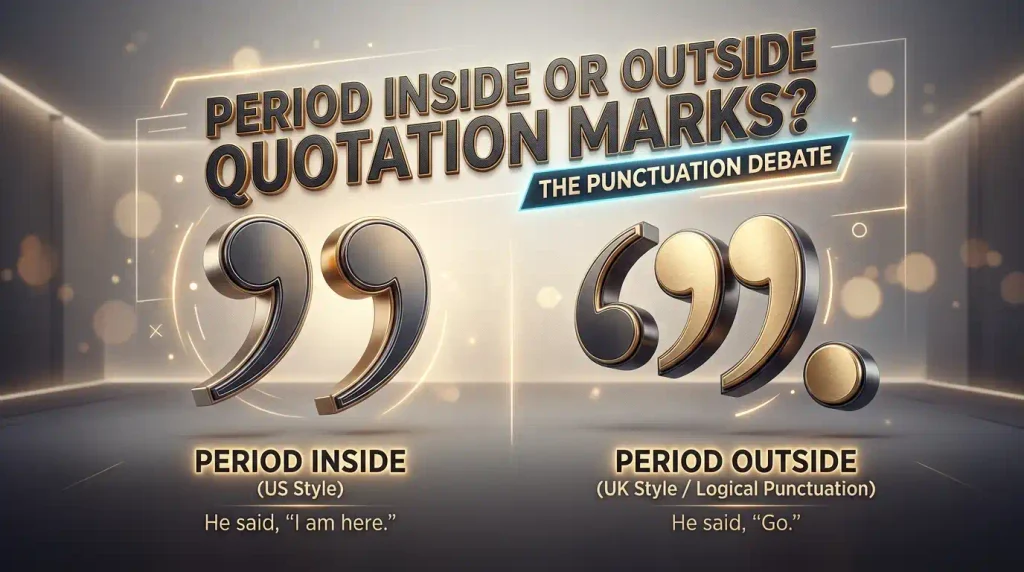
Does a period go inside quotes? In standard American English, yes. A period normally goes inside the closing quotation mark.
Correct: She said, “I’ll call you tomorrow.”
Incorrect in standard American style: She said, “I’ll call you tomorrow”.
If you are asking does a period go inside quotes or outside, the answer depends on the style you are using. American English normally puts periods and commas inside quotation marks. British English often follows a more logical system, placing punctuation according to whether it belongs to the quoted words.
That small difference causes many common grammar questions, including when to use a question mark, where to place a citation, and whether the full stop belongs before or after the quotation mark.
Does a Period Go Inside Quotes?
Yes, in standard American English, a period goes inside the closing quotation mark.
Examples:
- She called it “a great idea.”
- He said, “I agree.”
- The teacher described the answer as “correct.”
- The sign says “Keep Out.”
So, when does a period go inside quotes?
In American English, it normally goes inside whenever a sentence ends with quoted material:
She described the movie as “excellent.”
The rule also applies when the quotation contains only one word or a short phrase. Chicago describes this as the traditional American convention.
Does a Period Go Inside Quotes or Outside?
For American English, the answer is inside.
For British English, the answer can be inside or outside, depending on whether the punctuation belongs to the quoted material.
Compare:
American English:
She called the answer “wrong.”
British English:
She called the answer ‘wrong’.
The British example treats “wrong” as part of the larger sentence, so the full stop stays outside the quotation marks.
British style may instead place the full stop inside when the quotation itself is a complete sentence:
She said, ‘I am ready.’
The Chicago Manual of Style and MLA both explain this difference between traditional American and British quotation punctuation.
When Does a Period Go Inside Quotes?
In standard American English, a period goes inside the quotation marks when quoted material ends the sentence.
Examples:
- She said, “I’m tired.”
- He called the plan “unrealistic.”
- The report described the result as “unexpected.”
- My teacher called the answer “excellent.”
This rule does not depend on whether the period originally appeared in the quoted material.
That is one reason American quotation punctuation can seem unusual. The period is placed inside by convention.
What Is the Basic Pattern?
Remember this:
American English:
“quoted words.”
Not:
“quoted words”.
This pattern works for most ordinary American English writing.
Why Does Punctuation Go Inside Quotes?
Why does punctuation go inside quotes if the punctuation may not belong to the quotation?
The answer is style convention.
American publishers traditionally place periods and commas inside closing quotation marks. The convention dates back to older printing and typesetting practices and remains standard in American style guides. MLA explains that this placement became established in U.S. publishing even though the punctuation does not always logically belong to the quoted words.
Chicago makes the same point. Its guidance says that American-style punctuation traditionally puts the period inside the quotation marks even when the quotation forms only part of the sentence.
So do not try to decide every time whether the period “belongs” to the quote.
For ordinary American prose, use the established rule:
Period inside.
Does the Period Go Before or After the Quotation Mark?
If you mean does the period go before or after the quotation mark, the answer in American English is:
Before the closing quotation mark.
Correct:
She said, “Hello.”
The order is:
word + period + closing quotation mark
Not:
word + closing quotation mark + period
So:
Correct: “Hello.”
Incorrect: “Hello”.
Does a Period Go Inside the Quotation Marks When Citing?
This question needs a little more care.
When you add a Chicago author-date citation after a quotation, the citation normally comes before the final period.
Correct:
She described the result as “unexpected” (Smith 2024).
Not:
She described the result as “unexpected.” (Smith 2024).
Chicago explains that the parenthetical reference remains part of the sentence, so the sentence-ending period follows the citation.
This is different from an ordinary sentence without a citation:
She described the result as “unexpected.”
What If the Quotation Has a Question Mark?
A question mark can change the punctuation pattern.
For example:
Did she ask, “Are you ready?” (Smith 2024).
Here, the question mark belongs to the quoted question. The citation follows the closing quotation mark, and the sentence can still require a period after the citation under Chicago author-date style.
Do You Put a Period After a Quotation With a Question Mark?
Usually, no.
If a quotation ends with a question mark and that question mark ends the sentence, you do not add another period.
Correct:
She asked, “Are you ready?”
Incorrect:
She asked, “Are you ready?”.
The question mark already provides the sentence-ending punctuation.
However, a citation can create a different structure:
She asked, “Are you ready?” (Smith 2024).
In Chicago author-date style, the period comes after the citation because the citation is part of the larger sentence.
Do Quotes Go Before or After a Question Mark?
It depends on what the question mark belongs to.
The Quoted Words Are the Question
Put the question mark inside the quotation marks.
Example:
She asked, “Are you coming?”
The quoted words themselves form a question.
The Whole Sentence Is the Question
Put the question mark outside the quotation marks when the quotation is a statement.
Example:
Did she say, “You are coming”?
Here, “You are coming” is not a question. The larger sentence asks whether she said those words.
Chicago makes this distinction clear because moving the question mark inside would change the meaning of the quoted material.
An Easy Test
Ask:
Are the quoted words themselves a question?
If yes:
She asked, “Are you ready?”
If no:
Did she say, “You are ready”?
This simple test handles most question-mark problems.
Quotation Marks and Periods: Examples
Here are common quotation marks and periods examples in American English:
| Sentence | Correct? |
| She said, “I agree.” | Yes |
| She said, “I agree”. | No |
| He called it “strange.” | Yes |
| He called it “strange”. | No |
| “I agree,” she said. | Yes |
| She asked, “Are you ready?” | Yes |
| Did she ask, “Are you ready”? | No |
| Did she say, “You are ready”? | Yes |
| He called it “unusual” (Smith 2024). | Yes in Chicago author-date |
| He called it “unusual.” (Smith 2024). | Not the normal Chicago author-date pattern |
The key is to separate ordinary American quotation punctuation from citation punctuation.
Does the Full Stop Go Inside Quotation Marks?
If you are writing in American English, yes, normally.
If you are writing in British English, it depends.
In American English:
She described the plan as “unrealistic.”
In British English:
She described the plan as ‘unrealistic’.
But:
She said, ‘The plan is unrealistic.’
The second British example puts the full stop inside because the quoted material is a complete sentence.
Chicago describes British style as placing punctuation inside the quotation marks when it appeared in the original material and outside when it did not.
Does the Period Go Inside the Quotation Marks in British English?
Sometimes.
British English generally follows a more logical punctuation system.
Put the full stop inside when it belongs to the quoted sentence:
She said, ‘I am leaving.’
Put it outside when the quoted material is only part of the larger sentence:
She described the decision as ‘unfair’.
This differs from the traditional American rule, where periods normally go inside regardless of whether they logically belong to the quoted words.
Period Before or After Quotation Marks in British English
The period can go before or after the quotation mark in British English.
Period Before the Closing Quotation Mark
She said, ‘I am ready.’
The quoted material is a complete sentence.
Period After the Closing Quotation Mark
She called the decision ‘unfair’.
The quoted word is part of the larger sentence.
So, if you are searching for period before or after quotation marks British English, the answer is:
It depends on whether the full stop belongs to the quoted material.
What About Quotation Marks Before or After a Comma?
In standard American English, the comma normally goes inside the closing quotation mark.
Correct:
She said, “Come here,” and waved.
Correct:
“I agree,” he said.
Not:
She said, “Come here”, and waved.
Chicago and MLA both follow the American convention of putting commas inside closing quotation marks.
British English can place the comma outside when it does not belong to the quoted material.
Does a Comma Go Inside Quotation Marks?
In standard American English, yes.
Examples:
- “Hello,” she said.
- He called the plan “risky,” but approved it.
- The article describes the idea as “simple,” “clear,” and “useful.”
The American rule for commas is similar to the rule for periods.
But question marks and exclamation points work differently because their position depends on meaning.
What About Semicolons and Colons?
In American English, semicolons and colons generally go outside quotation marks.
Examples:
- She called the plan “risky”; I agreed.
- He described it as “a mistake”: a costly one.
The basic American pattern is:
- Period: inside
- Comma: inside
- Colon: outside
- Semicolon: outside
- Question mark: depends on meaning
- Exclamation point: depends on meaning
What If a Quote Ends With an Exclamation Point?
Put the exclamation point inside when the quoted words themselves are an exclamation.
Correct:
She shouted, “Stop!”
Do not add a second period:
Incorrect: She shouted, “Stop!”.
If the quotation is not an exclamation but the larger sentence is, the exclamation point can go outside:
I can’t believe he said “no”!
The same basic principle applies to question marks.
Period Inside or Outside Quotes: Chicago Manual of Style
The Chicago Manual of Style follows the traditional American convention: periods and commas normally go inside closing quotation marks.
For example:
- She called it “wrong.”
- He said, “I agree.”
- “Yes,” she replied.
Chicago also recognizes exceptions when following the normal rule would make quoted material misleading or incorrect.
This matters in technical writing, computer code, numbers, and exact strings.
For example, if a period outside the quotation marks makes it clear that the period is not part of the text someone needs to type, Chicago allows the punctuation to remain outside.
That gives you a practical Chicago rule:
Use the normal American convention unless doing so would change or confuse the quoted material.
Does a Period Go Inside Quotes When Citing a Title?
In ordinary American prose, a period normally goes inside quotation marks when a quoted title ends the sentence.
Example:
I enjoyed the short story “The Lottery.”
But titles that end with a question mark or exclamation point do not need an extra period.
Correct:
Have you read “Who’s Afraid of Virginia Woolf?”
Not:
Have you read “Who’s Afraid of Virginia Woolf?”.
Chicago confirms that a question mark can serve as the ending punctuation in this situation.
Does a Period Go Inside Quotes When the Quote Is Only One Word?
Yes, in standard American English.
Examples:
- She called him “kind.”
- The answer was “wrong.”
- The result was “unexpected.”
- They described the change as “necessary.”
The quoted word does not need to contain a period. The American convention places the sentence-ending period inside the closing quotation mark.
What Is the “3 Quote Rule”?
There is no universal English grammar rule called the “3 quote rule.”
If you mean a rule requiring exactly three quotations in an essay or article, no such standard grammar rule exists.
If you mean the three-quote rule used in purchasing or procurement, that is a separate business practice. It is not a rule about quotation marks or punctuation.
Is There a Three-Quotation Rule in Writing?
No.
You do not need exactly three quotations in an article, essay, or paragraph.
Use quotations when the exact words matter. Paraphrase when the idea matters more than the original wording.
The number of quotations should serve the purpose of the writing rather than an arbitrary rule.
Common Mistakes With Periods and Quotation Marks
Putting the Period Outside in American English
Incorrect:
She called the result “surprising”.
Correct:
She called the result “surprising.”
Adding Two Periods
Incorrect:
She said, “I agree.”.
Correct:
She said, “I agree.”
Adding a Period After a Question Mark
Incorrect:
She asked, “Are you ready?”.
Correct:
She asked, “Are you ready?”
Putting a Question Mark Inside a Statement
Incorrect:
Did she say, “I am leaving?”
Correct:
Did she say, “I am leaving”?
The first version changes the quoted statement into a question. The second correctly makes the larger sentence the question.
Mixing American and British Rules
Avoid switching styles in the same article.
If your website uses American English, keep periods and commas inside quotation marks throughout the article.
If you publish for a British audience, follow your chosen British style guide consistently.
American vs. British Quotation Punctuation
| Punctuation | American English | British English |
| Period | Usually inside | Depends on ownership |
| Comma | Usually inside | Depends on ownership |
| Question mark | Depends on meaning | Depends on meaning |
| Exclamation point | Depends on meaning | Depends on meaning |
| Colon | Usually outside | Usually outside |
| Semicolon | Usually outside | Usually outside |
| Primary quotation marks | Usually double | Often single |
The exact house style can vary, but the distinction between traditional American and British punctuation is well established in major style guidance.
Quick Reference: Where Does Punctuation Go?
| Punctuation | American English | Example |
| Period | Inside | She said, “Yes.” |
| Comma | Inside | “Yes,” she said. |
| Question mark | Depends | She asked, “Why?” / Did she say “why”? |
| Exclamation point | Depends | She shouted, “Run!” |
| Colon | Usually outside | He called it “wrong”: a serious error. |
| Semicolon | Usually outside | She called it “wrong”; I agreed. |
FAQ
Does a period go inside quotes?
Yes. In standard American English, a period normally goes inside the closing quotation mark.
When does a period go inside quotes?
In American English, a period goes inside when quoted material ends the sentence, including when the quotation is only a word or phrase.
Does a period go inside quotes or outside?
In American English, it normally goes inside. In British English, placement depends on whether the period belongs to the quotation or the surrounding sentence.
Do periods go into quotations?
Yes. Standard American English places periods inside closing quotation marks.
Is a period supposed to be inside or outside quotes?
For American English, inside. For British English, it depends on the relationship between the punctuation and the quoted material.
Why does punctuation go inside quotes?
American English follows a long-established typographic convention that places periods and commas inside quotation marks.
Does the period go before or after the quotation mark?
In American English, the period normally goes before the closing quotation mark:
She said, “Hello.”
Does a period go inside the quotation marks when citing?
With a Chicago author-date citation, the citation normally comes before the final period:
She called it “unexpected” (Smith 2024).
Do you put a period after a quotation with a question mark?
Normally, no. A question mark can end the sentence:
She asked, “Are you ready?”
But a citation can be followed by a period:
She asked, “Are you ready?” (Smith 2024).
Do quotes go before or after a question mark?
If the quoted words are the question, put the question mark inside:
She asked, “Are you ready?”
If the entire sentence is the question, put it outside:
Did she say, “You are ready”?
Does the full stop go inside quotation marks?
In American English, yes, normally. In British English, it depends on whether the full stop belongs to the quoted material.
Does the period go inside the quotation marks in British English?
Sometimes. British English generally places the full stop inside when it belongs to the quoted material and outside when it belongs to the larger sentence.
What is the 3 quote rule?
There is no universal three-quotation rule in English grammar. You do not need exactly three quotations in an essay or article.
What are some quotation marks and periods examples?
American English examples include:
- She said, “Yes.”
- He called it “strange.”
- “Yes,” she said.
- Did she ask, “Are you ready?”
- Did she say, “You are ready”?
Each example follows the rule that punctuation placement depends on the type of punctuation and what it applies to.
What about quotation marks before or after a comma?
In standard American English, the comma goes inside the closing quotation mark:
“I agree,” she said.
Does a period go inside quotes when the quotation is a title?
Usually yes in American English:
I read “The Lottery.”
If the title ends with a question mark, do not add a second period:
Have you read “Who’s Afraid of Virginia Woolf?”
Can a period go outside quotation marks in American English?
Yes, but only in special cases where the normal convention would make the quoted material unclear or incorrect. Chicago recognizes exceptions for technical material, code, numbers, and similar cases.
Final Answer: Does a Period Go Inside Quotes?
Yes, in standard American English, a period normally goes inside the closing quotation mark.
Correct:
She said, “I’ll be there.”
If you are writing in British English, the rule is different. Ask whether the full stop belongs to the quoted material. If it does, put it inside. If it belongs to the larger sentence, put it outside.
For question marks and exclamation points, do not use the period rule automatically. Ask what the punctuation applies to.
The easiest American English rule is:
Periods and commas go inside.
Colons and semicolons usually go outside.
Question marks and exclamation points depend on meaning.
Follow one style consistently, and your quotation punctuation will stay clear, correct, and easy to read.

Qaiser Abbas is a content strategist and SEO writer at PressoraNetwork creating research-driven content, language guides, and practical resources that help readers. Words That Matter, Content That Connects. My goal is to help people express their emotions with meaningful words and make every celebration more memorable.