
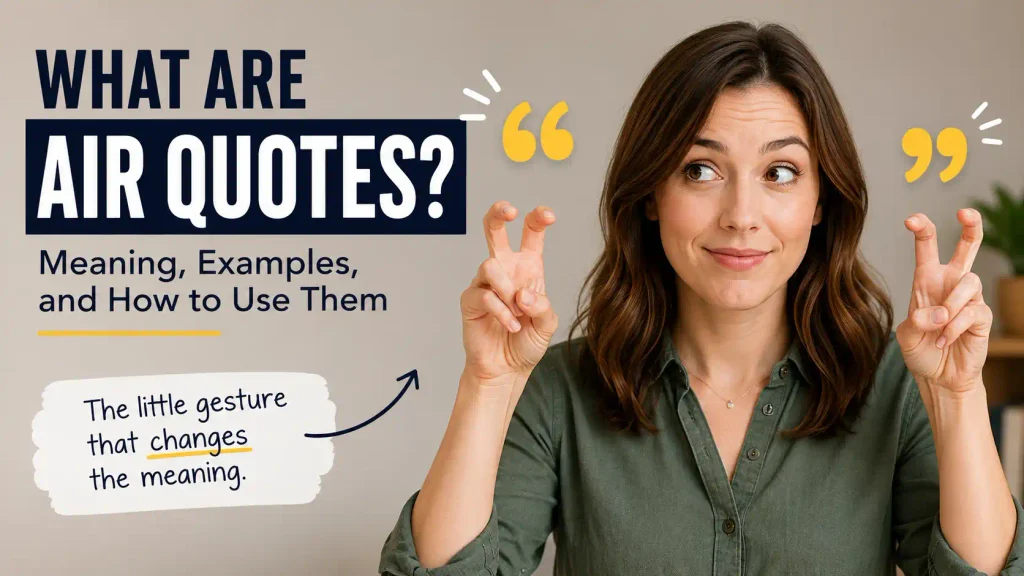
Air quotes are a simple hand gesture that can completely change the meaning of what you say.
You make them by raising your hands and bending your index and middle fingers to imitate quotation marks. People often use air quotes to show irony, skepticism, sarcasm, or distance from a particular word or phrase.
For example, saying someone is a “professional” while making air quotes may suggest that you do not fully believe they deserve that description.
What Are Air Quotes?
Air quotes are imaginary quotation marks made with your fingers while speaking.
The gesture usually involves raising both hands and flexing the index and middle fingers around a word or short phrase. According to major dictionaries, air quotes can show that a word is being used unusually, repeated from someone else, treated ironically, or viewed with skepticism.
Air quotes are also sometimes called:
- Finger quotes
- Finger quotation marks
- The quotation mark gesture
They are especially useful in spoken conversation because they add meaning that tone alone may not always communicate clearly.
What Do Air Quotes Mean?
The exact meaning of air quotes depends on the situation.
They often suggest one of the following:
- Irony: The speaker means something different from the literal words.
- Sarcasm: The speaker is making a mocking or humorous point.
- Skepticism: The speaker questions whether a description is accurate.
- Distance: The speaker does not fully agree with a particular label or phrase.
- Direct repetition: The speaker is repeating someone else’s exact words.
- Unusual wording: The speaker wants listeners to notice that a word is being used in a special way.
For example:
He’s taking a “short” break.
The word short becomes questionable. The speaker may be suggesting that the break will actually last a long time.
Air quotes work because they tell listeners:
Pay attention to this particular word. I may not mean it in the usual way.
How to Make Air Quotes
Making air quotes is simple.
- Raise both hands near shoulder or head level.
- Extend your index and middle fingers.
- Bend those fingers downward to mimic quotation marks.
- Repeat the movement while saying the word or phrase you want to highlight.
For example:
She calls herself a “food expert.”
You would make the gesture while saying food expert.
Air quotes usually work best around a short word or phrase. Trying to gesture around an entire sentence can feel awkward and distracting.
When Should You Use Air Quotes?
Air quotes are useful when you want to add a layer of meaning to spoken words.
To Show Skepticism
Use air quotes when you question whether a description is accurate.
He’s the “manager,” but he never makes any decisions.
The gesture suggests that the title may not reflect reality.
To Express Irony or Sarcasm
Air quotes can make an ironic meaning more obvious.
That was a very “productive” meeting.
The speaker may actually mean the meeting wasted everyone’s time.
To Repeat Someone Else’s Words
You can use air quotes when repeating a phrase that someone else said.
My boss told us to “trust the process.”
This can simply show that you are repeating someone else’s wording. The gesture does not always mean sarcasm.
To Question a Label
Air quotes can show that a title, description, or popular phrase feels exaggerated or misleading.
We stayed at a “luxury” hotel.
The speaker may be suggesting that the hotel was not actually luxurious.
Air Quotes Examples
Here are some everyday examples:
- He’s taking a “quick” break.
- She said she was “too busy” to call.
- Apparently, I’m the “responsible one.”
- That was a very “interesting” decision.
- He’s an “expert.”
- They promised a “short” meeting.
- She calls it a “temporary” problem.
- We’re having a “team-building” exercise.
- He said everything was “fine.”
- They offered us a “special” deal.
The meaning changes depending on context and tone.
Compare these two sentences:
We had a quick meeting.
This sounds neutral.
Now compare it with:
We had a “quick” meeting.
The air quotes suggest the meeting was probably not quick at all.
That small gesture changes how listeners interpret the word.
Are Air Quotes Always Sarcastic?
No.
Although air quotes are strongly associated with irony and sarcasm, they can also be used more neutrally.
For example:
She told me to “follow my passion.”
Here, the speaker may simply be repeating a phrase used by someone else.
Air quotes can also indicate:
- A familiar saying
- An unusual expression
- Someone else’s wording
- A phrase the speaker does not personally use
- A word that should not be interpreted literally
Context, tone of voice, and facial expression all affect the meaning.
Air Quotes vs. Regular Quotation Marks
Air quotes are related to written quotation marks, but they serve a slightly different purpose.
Regular quotation marks
In writing, quotation marks are commonly used for:
- Direct quotations
- Dialogue
- Certain titles, depending on style
- Words discussed as words
- Special or unusual usage
Example:
She said, “I’ll call you tomorrow.”
Air quotes
Air quotes are a physical gesture used while speaking.
They can indicate:
- Quotation
- Irony
- Skepticism
- Sarcasm
- Distance from a word or phrase
In writing, this skeptical or ironic use is similar to scare quotes—quotation marks used to signal that a word or phrase should not be accepted entirely at face value.
Why Do People Use Air Quotes?
Spoken language does not always make tone obvious.
The same sentence can mean very different things depending on how it is delivered.
Compare:
She’s my best friend.
Now imagine:
She’s my “best friend.”
The second version creates distance from the phrase best friend.
The gesture may silently communicate:
That’s what people call her, but I’m not completely sure I agree.
This makes air quotes useful for storytelling, humor, conversation, interviews, presentations, and everyday communication.
They can add personality to a sentence without requiring a long explanation.
Can Air Quotes Be Rude?
They can be.
Air quotes sometimes sound dismissive, mocking, or insulting, especially when used around words that describe another person.
For example:
He’s a “professional.”
This may question the person’s ability or credibility.
Likewise:
She’s a “friend.”
Depending on the situation, that could suggest distrust or disrespect.
The gesture itself is not automatically rude. The meaning depends on context, tone, and the relationship between the people speaking.
Still, if you use air quotes to challenge someone’s title or identity, expect the gesture to carry a critical tone.
A Brief History of Air Quotes
The gesture behind air quotes existed before the modern term became widely recognized.
Cambridge Dictionary notes that similar gestures were recorded as early as 1927, while Merriam-Webster lists 1989 as the first known use of the term air quotes itself.
Today, the gesture is widely recognized in English-speaking conversation as a quick visual signal that a word or phrase deserves special attention.
How to Use Air Quotes Naturally
Air quotes work best when they add something meaningful.
Use them for short phrases
A single word or short phrase is usually enough.
Natural:
He’s a “genius.”
Less natural:
He said he would probably arrive sometime after lunch if everything went according to plan.
Air quotes are most effective when used selectively.
Match your tone
Your voice and facial expression should support the meaning.
If you sound completely serious while using exaggerated air quotes, listeners may become confused about your intention.
Do not overuse them
Using air quotes too often can become distracting.
If every other phrase receives air quotes, the gesture loses its impact.
Use them when you genuinely want to signal irony, skepticism, unusual wording, or quotation.
FAQ About Air Quotes
What are air quotes?
Air quotes are imaginary quotation marks made with your fingers while speaking. They can indicate unusual wording, direct repetition, irony, or skepticism.
What do air quotes mean?
Air quotes often suggest that a word or phrase should not be taken completely at face value. Depending on context, they can express irony, sarcasm, skepticism, or distance from a particular expression.
How do you make air quotes?
Raise both hands, extend your index and middle fingers, and bend them while saying the word or short phrase you want to highlight.
Are air quotes always sarcastic?
No. They can also show that you are repeating someone else’s words, using an unusual phrase, or drawing attention to a particular expression.
Are air quotes rude?
They can be, especially when they question someone’s title, ability, or description. Context and tone determine whether the gesture feels humorous, skeptical, or insulting.
What is another name for air quotes?
Air quotes are sometimes called finger quotes, finger quotation marks, or a quotation mark gesture.
Conclusion
Air quotes are a small gesture with a surprisingly big effect.
By mimicking quotation marks with your fingers, you can signal irony, skepticism, sarcasm, unusual wording, or someone else’s exact phrase.
The key is context.
Used naturally, air quotes can add humor and personality to a conversation. Used carelessly, they can sound dismissive or mocking.
So the next time someone describes themselves as a “professional,” pay attention to their hands. They may be telling you more than their words alone suggest.

Qaiser Abbas is a content strategist and SEO writer at PressoraNetwork creating research-driven content, language guides, and practical resources that help readers. Words That Matter, Content That Connects. My goal is to help people express their emotions with meaningful words and make every celebration more memorable.