
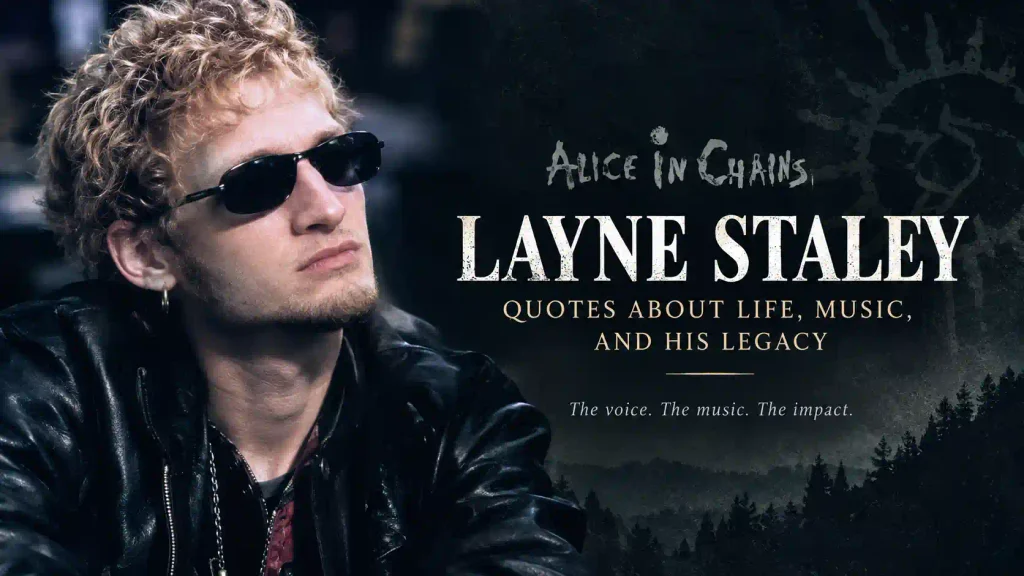
Today, Layne Staley quotes continue to interest fans who want to understand the man behind the music. His interviews reveal a thoughtful musician who spoke openly about creativity, addiction, personal struggles, and the difference between his public image and his real identity.
Layne Staley was one of the most distinctive voices in rock music. As the lead singer of Alice in Chains, he helped shape the Seattle grunge sound with haunting vocals, powerful harmonies, and songs that explored difficult emotions.
This collection explores his documented interview statements, his songwriting with Alice in Chains and Mad Season, and the stories behind popular quotations attributed to him. It also answers common questions about his death, his last words, and his connections to Kurt Cobain and Chris Cornell.
Because many online quote collections mix authentic statements with unverified sayings, accuracy matters. Song lyrics, interview quotations, and original tribute captions are identified separately throughout this article.
Short Layne Staley Quotes
Some of the most memorable Layne Staley quotes come from interviews rather than song lyrics. His February 1996 interview with Rolling Stone offers a particularly revealing look at how he viewed his career and personal struggles.
1. “My bad habits aren’t my title. My strengths and my talent are my title.”
— Layne Staley, Rolling Stone, February 8, 1996.
This statement reflects Staley’s frustration with being defined entirely by addiction. He wanted people to recognize his abilities and creative work rather than reduce his identity to his struggles.
2. “We recorded a few months of being human.”
— Layne Staley, Rolling Stone, February 8, 1996.
Staley used this phrase while discussing the experiences behind Alice in Chains’ songs. It captures the personal nature of the band’s music without suggesting that every song has one fixed interpretation.
These two short statements offer a useful starting point for anyone looking for authentic Layne Staley quotes rather than sayings copied across social media without reliable sources.
Layne Staley Quotes About Life
Staley’s life was complicated, and his interviews reveal more than the dark image sometimes associated with grunge. He spoke about identity, relationships, spirituality, and the difficulty of living with personal struggles.
3. “My bad habits aren’t my title. My strengths and my talent are my title.”
This statement deserves attention beyond its popularity as a quote. Staley was pushing back against the idea that his personal difficulties were the only important part of his story.
His words remain relevant to anyone who feels defined by a mistake, a difficult period, or another person’s judgment.
4. “I’ve always looked for the perfect life to step into.”
— Layne Staley, Pandemonium, Vol. 29, April 1995, as reproduced in published quote collections.
In the same interview, Staley reflected on the fact that he continued to return to himself regardless of where life took him.
The thought offers a glimpse into his search for contentment. It also reminds readers that changing circumstances does not automatically resolve every internal struggle.
5. Looking Beyond Public Image
Staley’s interviews show why it is important to understand the person behind a famous name. He was a musician with interests and ambitions beyond his public reputation.
His experience illustrates a broader truth: people are more complicated than the labels attached to them. A person’s difficulties may be part of their story, but they do not represent the whole person.
6. Finding Meaning in Difficult Experiences
Many listeners connect with Alice in Chains because the music gives voice to emotions that are difficult to discuss openly.
Staley’s performances could communicate sadness, anger, uncertainty, and vulnerability without offering easy answers. That honesty is one reason his work continues to resonate with new generations of fans.
Layne Staley Quotes About Music and Creativity
Staley’s contribution to rock music went far beyond his vocal range. His delivery, songwriting, and collaboration with guitarist Jerry Cantrell helped give Alice in Chains its unmistakable identity.
7. On the Meaning Behind His Songs
In his 1996 Rolling Stone interview, Staley explained that the band’s songs reflected what was happening in his mind at the time.
This perspective helps explain the emotional immediacy of Alice in Chains’ music. The songs were connected to lived experiences rather than designed around one universal message.
8. On Creative Identity
Staley’s career demonstrates that artistic identity can develop through collaboration. His vocal harmonies with Jerry Cantrell became one of the defining characteristics of Alice in Chains.
Their voices created a contrast between melodic beauty and heavy, unsettling instrumentation. That balance helped the band stand apart from many of its contemporaries.
9. On the Connection Between Music and Emotion
Staley’s voice could sound fragile in one moment and overwhelming in the next. That contrast made his performances memorable and allowed the band’s songs to communicate conflicting emotions.
His influence can still be heard in alternative metal, grunge revival, and modern rock, particularly among singers who combine melodic singing with raw emotional intensity.
Layne Staley Song Quotes and Lyrics
People searching for Layne Staley song quotes often want memorable lines from Alice in Chains or Mad Season. His songwriting is a major part of his legacy, but song lyrics are copyrighted works and should not be reproduced in long passages without permission.
The following songs are excellent starting points for fans who want to explore his writing and performances.
10. “Nutshell” — Alice in Chains
Released on the 1994 EP Jar of Flies, “Nutshell” is known for its restrained arrangement and vulnerable atmosphere.
Why listen: The song is often associated with isolation, exposure, and the difficulty of explaining private pain to others.
11. “Down in a Hole” — Alice in Chains
Featured on the 1992 album Dirt, “Down in a Hole” pairs a heavy musical atmosphere with emotionally charged vocals.
Why listen: Its themes of regret and emotional distance make it one of the band’s most affecting recordings.
12. “Would?” — Alice in Chains
“Would?” is one of the band’s best-known songs and appeared on Dirt. Its distinctive bass line and changing vocal intensity give it a sound that remains instantly recognizable.
Why listen: The song explores judgment and understanding, inviting listeners to consider how quickly people form opinions about others.
13. “Angry Chair” — Alice in Chains
Staley wrote “Angry Chair,” which appears on Dirt. Its unsettling sound and distinctive structure make it an important example of his own songwriting.
Why listen: It provides a closer look at Staley’s creative voice beyond his work as a vocalist.
14. “River of Deceit” — Mad Season
Staley sang with Mad Season, a project featuring musicians from Seattle’s alternative-rock community. “River of Deceit” appeared on the group’s 1995 album Above.
Why listen: Its reflective mood shows another side of Staley’s artistry, distinct from the heavier sound of Alice in Chains.
Best Layne Staley Lyrics to Explore by Mood
If you are searching for the best Layne Staley lyrics, start with songs that fit the emotion you want to explore.
- Loneliness and vulnerability: “Nutshell”
- Regret and emotional struggle: “Down in a Hole”
- Judgment and reflection: “Would?”
- Dark, unsettling intensity: “Angry Chair”
- Personal reflection: “River of Deceit”
These descriptions are interpretations of the songs, not quotations from Staley or claims that he assigned each track a particular meaning.
Layne Staley Quotes About Drugs and Addiction
Searches for Layne Staley quotes drugs often focus on his candid comments about addiction. These statements deserve context because Staley himself objected to the idea that drug use was the defining feature of his identity.
In his 1996 Rolling Stone interview, he discussed how his initial experiences with drugs had changed into a painful struggle. He also explained that he did not want fans to interpret his music as an endorsement of heroin use.
His comments offer a sobering perspective on addiction and its consequences.
15. His Warning About Romanticizing Drugs
Staley recognized that some listeners misunderstood the subject matter of his songs. Writing about drugs did not mean he wanted people to imitate his experiences.
That distinction remains important when discussing artists whose work explores substance use. Describing a difficult experience is not the same as recommending it.
16. Why His Words Still Matter
Staley’s experience illustrates several important lessons:
- Addiction can become destructive even when someone initially believes a substance is helping.
- Fame and artistic success do not eliminate personal suffering.
- Music can describe painful experiences without making those experiences desirable.
- A person’s struggles should not erase their achievements, relationships, or individuality.
Remembering Staley with compassion means acknowledging his addiction without romanticizing it.
Rare Layne Staley Quotes and Their Sources
Fans searching for rare Layne Staley quotes should look beyond quote graphics and reposted lists. Older magazine interviews, original recordings, and contemporary reporting can provide better evidence of a quotation’s wording and context.
Three useful starting points are:
- “Alice in Chains: To Hell and Back” — Rolling Stone, February 8, 1996. This interview discusses Staley’s public image, songwriting, and experiences with addiction.
- “Layne Staley Unchained” — Pandemonium, Vol. 29, April 1995. This interview is associated with his reflections on his identity, interests, and search for a satisfying life.
- Recorded interviews and archival music coverage. These can help establish whether a quotation was spoken by Staley or merely attributed to him later.
A quote is not necessarily authentic because it appears on a vintage photograph or a website that calls it rare. Whenever possible, identify the original publication and compare the wording with the source.
How to Identify an Authentic Quote
Before publishing a quotation under Staley’s name, ask three questions:
- Can you identify the original interview, recording, or publication?
- Does the original source support the exact wording?
- Has the quotation been shortened or edited in a way that changes its meaning?
If the answer is unclear, label the attribution as uncertain or leave the quotation out. Accuracy is more valuable than adding another popular saying to a list.
Death Layne Staley Quotes and His Final Days
Searches for death Layne Staley quotes often combine his reflections on mortality with questions about the circumstances of his death. These subjects should be handled carefully because online accounts sometimes present speculation as fact.
Staley died on April 5, 2002, at age 34. His death was attributed to an overdose involving heroin and cocaine, his body was discovered later that month after he had been largely absent from public life.
His death was a tragedy, but it should not overshadow his artistic achievements or reduce his entire life to its final chapter.
What Were Layne Staley’s Last Words?
There is no reliably established public record confirming Layne Staley’s exact last words.
Stories about an alleged final statement circulate online, but a repeated claim is not proof. Without credible documentation, it would be misleading to present any particular sentence as his confirmed last words.
For readers interested in his thoughts about mortality, his documented interviews are a more reliable source than unsourced claims about his final hours.
What His Legacy Means Today
Staley’s music continues to connect with listeners because it treats difficult emotions seriously. His performances helped make vulnerability part of the sound of alternative rock.
Remembering him honestly means recognizing his talent, acknowledging his struggles, and avoiding sensational stories that cannot be substantiated.
Kurt Cobain Quotes and Chris Cornell Quotes: How They Connect to Layne Staley
Layne Staley, Kurt Cobain, and Chris Cornell helped define a remarkable era of alternative rock. Their careers are often discussed together because of their connection to Seattle’s music scene, but each artist had a distinct voice and creative identity.
What Did Kurt Cobain Say About Layne Staley?
Reliable direct quotations from Kurt Cobain specifically about Staley are not as readily established as many online posts suggest.
Staley discussed Cobain in interviews, including a 1995 conversation in which he reflected on seeing Cobain’s personality change during a difficult period. Staley’s account provides evidence of his own perspective, but it should not be reversed and presented as something Cobain said about him.
If you encounter a supposed Cobain quote about Staley, check for an original interview or a reputable publication before repeating it.
Chris Cornell Quotes and Layne Staley’s Legacy
Chris Cornell, the lead singer of Soundgarden and later Audioslave, was another major voice in Seattle’s alternative-rock movement.
Fans often search for Chris Cornell quotes alongside Layne Staley quotes because both singers became known for expressive vocals and emotionally intense music.
However, their statements should remain separate. A quotation attributed to Cornell is not evidence of Staley’s views, and similarities between their musical styles do not establish that one artist said something about the other.
Layne Staley Quote Wallpapers and Captions
A Layne Staley quote wallpaper can be a meaningful tribute for fans who want to celebrate his music and legacy.
For an accurate and respectful design, consider these options:
- Minimalist tribute: A monochrome portrait, his name, and his lifespan.
- Album-inspired design: Officially licensed Alice in Chains artwork or a legally obtained concert photograph.
- Interview quotation: A short, verified statement with the publication credited.
- Original tribute caption: A newly written message about music, memory, or artistic influence that is clearly not attributed to Staley.
If you use song lyrics, remember that lyrics are protected by copyright. A short excerpt may still require permission depending on how it is used. Do not assume that a line becomes free to use simply because it appears on a fan-made wallpaper.
Original Layne Staley Tribute Captions
The following lines are newly written captions inspired by the themes of remembrance and music. They are not Layne Staley quotes.
- “Some voices never leave the songs that made us feel understood.”
- “Remember the music, honor the person, and keep the story honest.”
- “A lasting voice can turn private pain into a shared experience.”
- “His music remains a part of rock history, long after the final note.”
These original captions can be used as starting points for a tribute design, subject to the image and platform’s own usage requirements.
Frequently Asked Questions
What is Layne Staley’s most famous quote?
There is no universally accepted ranking of Layne Staley quotes. His documented statement about not letting his bad habits define him is among his most revealing interview remarks because it directly addresses his identity beyond addiction.
What are the best Layne Staley lyrics?
“Nutshell,” “Down in a Hole,” “Would?,” “Angry Chair,” and Mad Season’s “River of Deceit” are strong starting points. Each showcases a different aspect of Staley’s vocal delivery and songwriting legacy.
What did Layne Staley say about drugs?
In a February 1996 Rolling Stone interview, Staley discussed how drugs had initially seemed to work for him but eventually became a source of suffering. He also said he did not want his fans to view heroin as something cool.
What were Layne Staley’s last words?
His exact last words have not been reliably established in the public record. Claims about his final statement should be treated as unverified unless credible evidence supports them.
What did Kurt Cobain say about Layne Staley?
A widely recognized, reliably sourced direct quotation from Cobain specifically about Staley is difficult to establish. Check original interviews and reputable historical sources rather than relying on quote graphics.
What is the most iconic quote ever?
There is no objective answer. What makes a quote iconic depends on its cultural impact, historical context, and personal meaning to the people who remember it.
Where can I find rare Layne Staley quotes?
Start with original magazine interviews, recorded conversations, archived publications, and reputable music journalism. The February 1996 Rolling Stone interview and the April 1995 Pandemonium interview are useful starting points.
Can I use Layne Staley quotes on a wallpaper?
Short, properly attributed interview excerpts may be suitable for some personal designs, but usage rights depend on the quotation, image, and intended use. Song lyrics and album artwork can be protected by copyright, so verify permissions before using them commercially.
Conclusion
Layne Staley remains one of the most influential voices of the Seattle grunge era. His work with Alice in Chains and Mad Season combined powerful vocals, emotional vulnerability, and songwriting that continues to resonate with rock fans.
The most meaningful Layne Staley quotes are those that can be traced to reliable sources and understood in context. His documented interviews offer insight into his life, while his songs preserve the creative work that made him memorable.
His legacy deserves more than viral sayings and speculation about his final days. It deserves an honest appreciation of his talent, compassion for his struggles, and respect for the music he left behind.

Qaiser Abbas is a content strategist and SEO writer at PressoraNetwork creating research-driven content, language guides, and practical resources that help readers. Words That Matter, Content That Connects. My goal is to help people express their emotions with meaningful words and make every celebration more memorable.